Why every Awwwards site in 2026 is a design-engineering project
The handoff is dead. In 2026 the sites winning Awwwards, FWA, and CSS Design Awards are all built by people who design in the browser and engineer in the design tool. Here is what that actually looks like in production — React, Framer Motion, GSAP, WebGL, and the studio operating model that makes it ship.
Ger'Quia Abner
Founder & Design Engineer · TAGDESIGNS
There was a moment, sometime around the second half of 2025, when the Awwwards SOTD page stopped looking like a portfolio and started looking like a tech demo. Sites compete on physics now. On WebGL shaders, on scroll-bound 3D, on type that responds. The handoff between designer and developer — that polite Friday afternoon ritual where a Figma link gets emailed and the front-end engineer translates intent into JSX — has quietly stopped being where the work happens.
The handoff is dead
The reason is not a fashion trend. It is mechanical. The interactions that win in 2026 — magnetic cursors, kinetic type, scroll-bound video, GSAP timelines that gate themselves to viewport progress, WebGL hero sections that respond to mouse and touch — cannot be designed in Figma. They can be sketched there. They can be storyboarded there. They cannot be specified there, because the design tool has no concept of frame budget, easing curves, scroll velocity, GPU memory, or the fact that an iPhone 14 will throttle the shader after eight seconds.
The work has to happen in the browser. The person making the work has to be the person who can also open the dev tools.
“The winning front-end in 2026 is a design decision, not a deliverable.
”
The new stack (and why it matters)
The studios shipping the work that gets cited all share the same toolchain. React and TypeScript for the application skeleton. Motion (formerly Framer Motion, now at motion.dev) for component-level interaction — entrance, exit, layout choreography. GSAP for scroll-bound timelines that need millisecond control. Three.js or React Three Fiber for WebGL surfaces. Tailwind for the design-token layer so the brand system stays editable without rewriting a stylesheet. Vite for the dev loop, because every second of HMR latency taxes the iteration count.
It is not the stack itself that matters. It is what the stack removes. There is no longer a translation step between intent and result. Open the file, change the spring stiffness from 120 to 80, save, see the new feel in 80ms. That feedback loop is the design tool now.
// THE RULE OF FIVE TOOLS
If your design and engineering pipeline involves more than five tools, you are losing fidelity at every boundary. Every export, every import, every npm run build between intent and pixel is a place the work degrades.
Motion as the deliverable
Motion is no longer the polish layer. It is the deliverable. The hierarchy of attention on a modern landing page is set by which element moves, not which element is biggest. Magnetic CTAs move toward the cursor. Headlines spell themselves character by character on scroll. Product UIs parallax against the gradient behind them. The visitor's eye follows kinetic energy the way it used to follow contrast.
This means the design decisions are now timeline decisions. How long does the headline take to spell itself? Which character lands the half-beat before the CTA enters? Does the scroll reveal feel elastic or mechanical? You cannot answer those questions in a static frame. You answer them by feeling the result, in the browser, on a real device, at production frame rate.
The operator model
The studio model that survives this shift is the operator model. One person — or one very small team — who designs and engineers in the same continuous loop. No translation. No "the developer didn't get the easing right." No "the designer didn't understand the constraint." The person who specifies the spring stiffness is the person who sets the brand voice. They are the same decision.
That is also why the agency model is bleeding talent. The senior designer who can code, and the senior engineer who can compose a frame, do not want to wait three days for someone else to translate their work. They want the loop to be tight, the dev tools to be open, and the result to ship the same week. The studios that hire for both halves of that brain are the studios shipping the work that wins in 2026.
The handoff is dead. The operator era has started. Build accordingly.
// KEEP GOING
Further Insights & Analysis
Why flat backgrounds are starting to feel dead
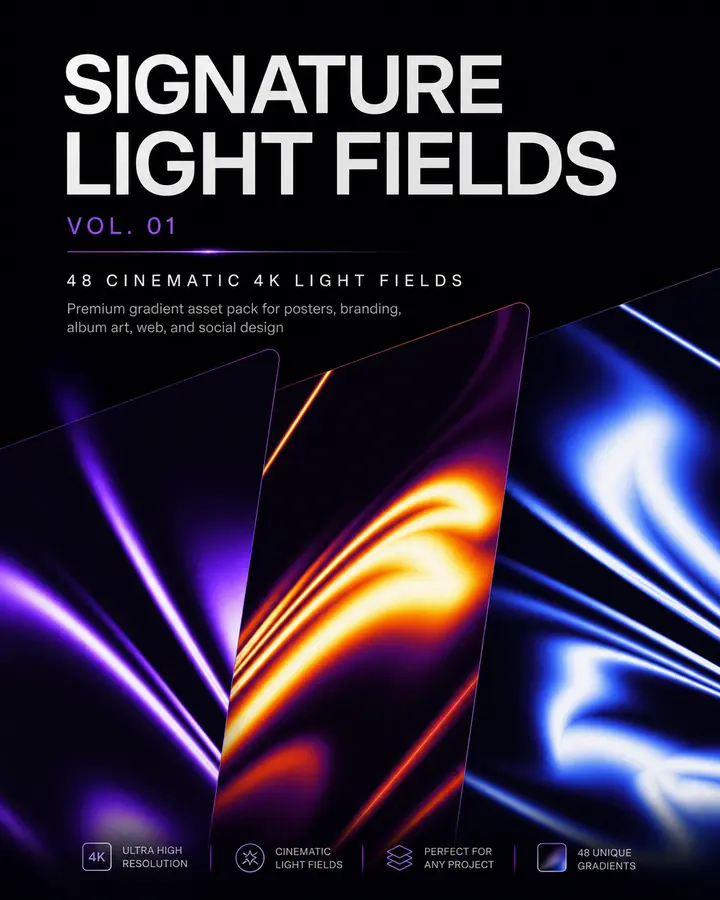
Digital design spent years becoming cleaner and easier to generate. Now the pendulum is moving toward atmosphere, texture, dimensionality, and visible creative intention. Here is how authentic light fields transform posters, album artwork, campaigns, and web interfaces.
The 5-second SaaS headline test (and how to write one that survives)
Most SaaS landing pages lose the visitor in the first five seconds — not because the product is bad, but because the headline is vague. Here is the rubric we built into TasteCourt to score them, and the four-step rewrite that turns a confusing page into a converting one.
AI brand systems in production: the end of the static brand guide
Static brand guides die in the first quarter. In 2026 the studio ships brand systems as living code — design tokens, generative palettes, AI-assisted asset libraries, and component primitives that compile into Figma, Photoshop, and the production website at once. Here is the architecture, the tooling, and the workflow.